How to Read a Gold Hallmark
A tiny stamp on gold can tell you purity, sometimes origin, sometimes the maker. Here is how to find it, decode it, and what its absence really means.

You found a number stamped somewhere on a gold piece, maybe 750 or 18K, and you want to know if it means what you think it means. It usually does. A hallmark is a small, deliberate stamp that records the purity of the gold and, in some systems, who is responsible for that claim. Reading it correctly takes two minutes once you know where to look and what the numbers stand for.
What a hallmark actually tells you
At minimum, a hallmark tells you the fineness of the metal, which is the proportion of pure gold in the alloy. Pure gold is soft, so almost everything sold as gold jewelry is mixed with other metals for strength. The hallmark is the maker’s or the assay office’s formal statement of how much of that mix is actually gold.
In countries with a mandatory hallmarking system, a second and sometimes a third mark can appear alongside the purity stamp. A sponsor’s mark or maker’s mark identifies who made or is responsible for the piece. An assay office mark, where the system requires independent testing, shows that a third party verified the purity claim rather than taking the maker’s word for it. Not every country requires this. Many, including large jewelry markets, leave hallmarking voluntary or apply it only above a certain weight or value threshold.
This matters because a missing third-party mark is not automatically a red flag. It depends entirely on which country’s law applied when the piece was made and sold, and on the size of the piece itself.
Where to actually find it
On a ring, look on the inside of the band. On a bracelet or necklace, check the clasp or a small tag soldered near it. On earrings, look on the post or the back of the setting. On a mounted stone, the mark is often stamped into the metal of the bezel, the small rim of metal that holds the gem in place, usually on the underside where it will not scratch the wearer or catch on fabric.
The mark itself is small by design. It has to be, since stamping it any larger would damage the piece. A jeweler’s loupe, the small magnifying glass used to inspect stones and metal, makes this trivial. A phone camera set to macro focus and a bright light will often do the job just as well if you do not have one.
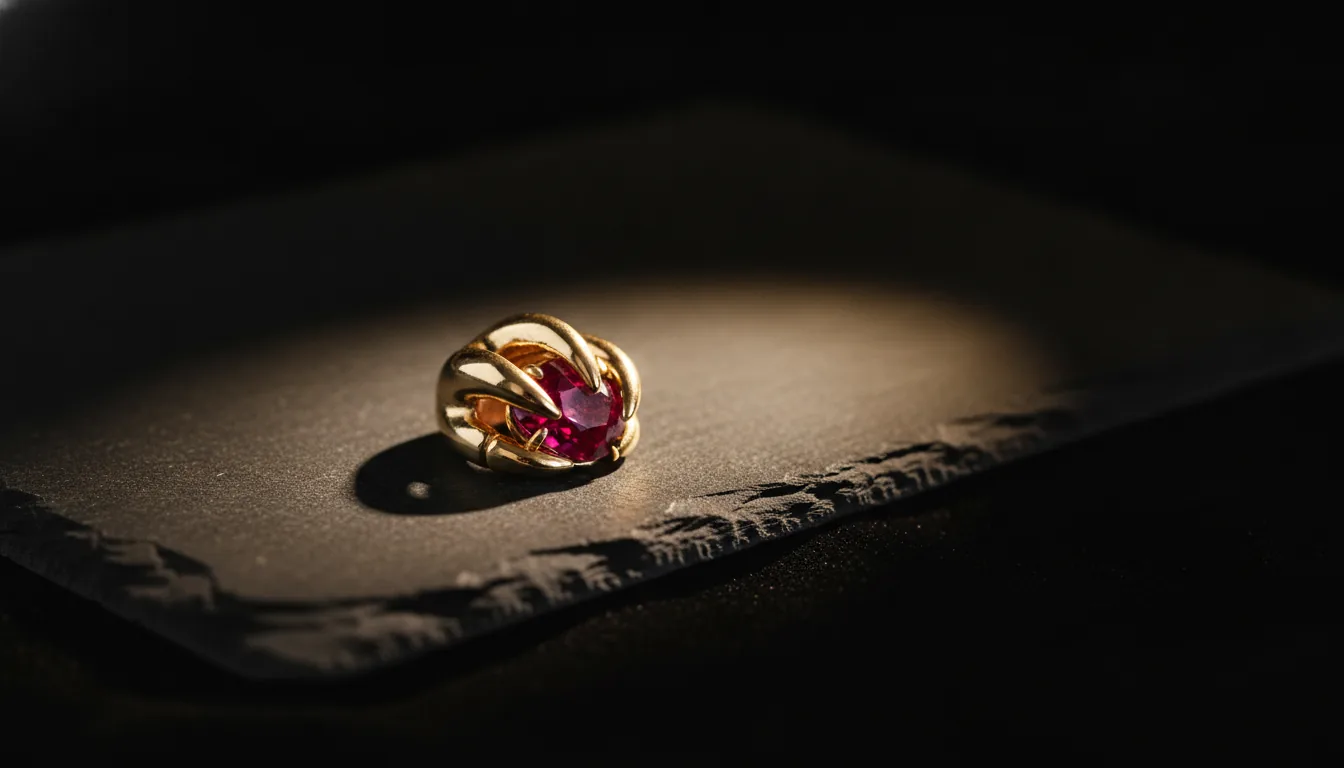
If you are inspecting a piece with very fine gold detailing rather than a single solid band, such as a small setting holding a stone against a soft-sculpted or non-metal body, do not expect a stamp on every individual gold element. Hallmarking law generally applies to the piece as a whole, and on small or composite settings a legible stamp may sit only in one place, or the maker may rely on paperwork instead. This is one of the questions worth asking before buying any collectible that mixes materials, and it is exactly the kind of thing covered in twelve questions before buying.
Reading the numbers: 750, 585, 916 and the rest
Most purity marks are written as a number out of one thousand, called the millesimal fineness. It looks technical but the math is simple.
750 means 750 parts gold out of 1000, which is 75 percent gold. That is 18 karat, since karat is out of 24 and 18 divided by 24 is also 75 percent. This is the number you want on anything sold as 18K gold.
585 or sometimes 583 means 58.5 percent gold, which is 14 karat. 417 is 10 karat. 999 or 999.9 is as close to pure gold as jewelry gets, which is 24 karat, and it is rarely used in fine settings because pure gold is too soft to hold a stone securely or resist daily wear.
You may also see the karat written directly, as 18K, 14K, or similar, sometimes alongside the millesimal number and sometimes instead of it. Both describe the same fact. If a piece is stamped 18K but has no matching 750 anywhere and no paperwork backing the claim, that gap is worth asking about directly. For a fuller explanation of why 18K is the number collectors should be looking for in the first place, see why 18K and not 24K.
When there is no hallmark at all
An unmarked piece is not proof of anything on its own, in either direction. It could mean the jurisdiction where it was made does not require hallmarking. It could mean the piece is too small or too delicate to stamp without damaging it. It could also mean the gold content is exactly what the seller says it is, and the only record of that claim lives on a certificate rather than on the metal itself.
It could also mean the metal is not what it claims to be. This is exactly why a missing hallmark should prompt a question, not a conclusion. Ask what the seller relies on instead. A serious seller will have an answer ready, whether that is a hallmark you simply have not located yet, an assay certificate, or a signed statement of the exact specification.
A hallmark and a certificate do different jobs
A hallmark verifies the metal. It says nothing about the stones set into it, the maker, the edition, or the story behind the piece. A certificate of authenticity can cover all of that, including the metal, if it is specific enough to say so in writing.
This is the model behind pieces that combine gold with other materials in ways a standard hallmarking system was never built to handle. Lux Monsters settings are solid 18K gold holding natural diamonds, rubies, and sapphires, set into a hand-finished body rather than a conventional ring or bracelet. Each piece ships with a signed certificate carrying a unique serial number, which states the specification in writing rather than relying on a stamp that has nowhere practical to sit. It is a different mechanism aimed at the same goal, which is proof you can check against the object in front of you. What a certificate should actually include, and how to tell a thorough one from a thin one, is worth reading before you take any seller’s word for it, at what a certificate of authenticity should include.
Whichever method a piece relies on, the standard you should hold it to stays the same. You should be able to check the claim against something concrete, whether that is a stamp under a loupe or a document with a serial number that matches the object in your hand, and you should be able to see the process for doing that laid out before you buy, not after. Details on how that verification actually works in practice are at verify.
What to do if you are still unsure
Look under strong light with magnification before you conclude anything. A worn or poorly struck mark can look blank to the naked eye and perfectly legible under a loupe. If you still find nothing, ask the seller directly what backs the purity claim, and expect a specific answer rather than a general reassurance.
A stamp on gold is a small thing to check and it tells you something real. Treat its presence as useful information, and treat its absence as a question to ask rather than an answer in itself.