How We Set 18K Gold Bezels on Plush
A workshop walkthrough of how 18K gold bezels and real gems meet soft plush without compromise, from rigid eye module to reinforced receiving structures.
Plush is soft. Gold is not. A fine jewelry setting assumes the surrounding material can hold its shape. A plush body assumes it will be squeezed. Those two truths fight each other. Most brands pick a side. We did not.
This post is a walk through our workshop. How the 18K gold bezel meets the soft body. How the real stones stay set through decades of handling. What happens inside a Rare piece that you never see.
Why most houses refuse to try
If you ask a jewelry house to set a diamond into a plush toy, they will politely decline. The soft substrate is the problem. A traditional prong or bezel setting needs a rigid base. Without rigidity, the prongs flex, the bezel distorts, the stone loosens. Within six months the gem is gone.
If you ask a plush manufacturer to add real gems, they will also decline. They work in embroidery and safety eyes, not in metal. The tolerances are wrong. The tools are wrong. The thinking is wrong.
What Lux Monsters built is a third discipline. A jeweler’s precision working inside a textile object. The bridge between the two is something we call the eye module.
The eye module, explained
The eye module is a rigid internal structure that sits behind the plush face. Think of it as a small armored disc. It is the only part of the figurine that behaves like a jewelry surface. Everything else stays soft.
Each module is machined to hold a gem-set bezel at its front. The bezel is 18K gold, sized to the stone, and seated into the module with the same tolerances we would use on a signet ring. The back of the module distributes force. When you squeeze the body, the plush compresses around the module, not into it. The gem never moves.
We machine the module in two halves, front and back, and seal them together with the bezel locked in the middle. That makes the setting sandwich-bonded from three sides. A prong-set stone has one line of defense. Our bezel has three.
Why 18K, not 14K, not plated
Plating would be cheaper. It would also fail. Gold plating wears through with handling, and a plush toy is handled more than a piece of jewelry. Once the plating wears, the base metal shows, and the whole object is ruined.
Fourteen karat is harder than 18K, which sounds good until you remember that hardness in a bezel is a liability. A hard bezel resists being hammered down around the stone during setting. The stone sits loose inside a bezel that never fully closes on it. Eighteen karat has the right balance of workability and longevity. It takes the polish we want, it closes cleanly around the girdle of the stone, and it does not yellow or oxidize with time.
This is also why every bezel we set is solid, not hollow. A hollow bezel can be crushed. A solid bezel cannot.
The reinforced receiving structure
The eye module does its job only if the surrounding plush can hold it in place. A loose module moves under the fabric. A shifting module strains the stitching. We solved this with what the factory team calls the receiving structure.
The receiving structure is a reinforced internal collar sewn into the plush body at the eye positions before stuffing. It is built from a layered composite, firm enough to grip the module, soft enough to disappear when the piece is held. The collar surrounds the module on all sides. When the body is filled with high-rebound poly fiberfill, the fill presses the collar against the module with even pressure.
That means the module cannot rotate. It cannot migrate. It cannot work loose through years of being picked up, held, displayed, and re-boxed. The soft body handles the impact. The rigid module handles the stone.
Stitch topology
A normal plush toy has a simple seam pattern. Our Rare pieces do not. The seam topology around the eye area is redesigned from scratch. We route the stitching so that no seam passes directly under the bezel. Every seam load is carried around the module, not through it.
This is invisible from the outside. From the inside, it looks like a small web of reinforced stitches fanning out from each eye position. Those stitches distribute pulling force. If a collector tugs the ear, the force does not travel to the eye. It dissipates into the web.
Each Rare piece passes through this stitching step by hand. A machine cannot read the curvature of the module and adjust accordingly. A trained seamstress can.
Setting the stone
Once the plush body is built and the module is seated, the bezel is set. This is the last step in the workshop, and the most delicate.
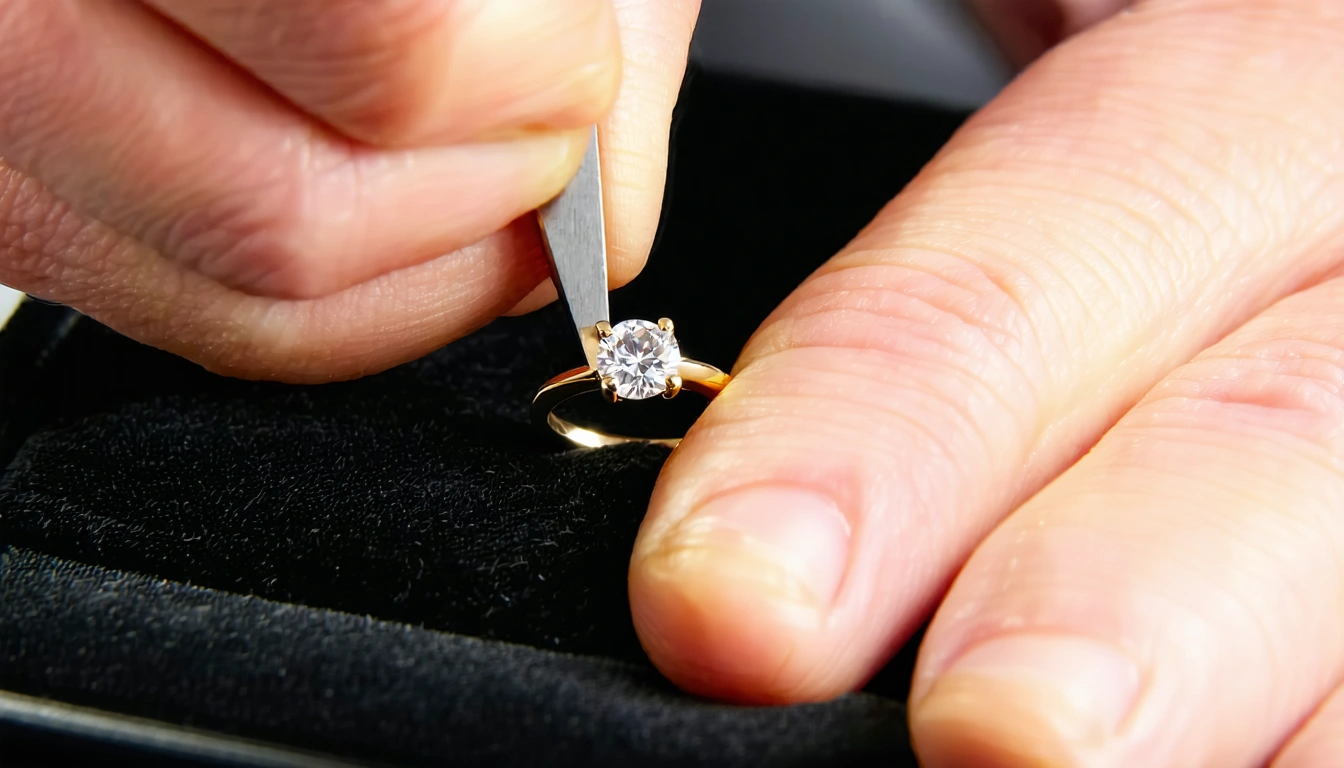
The stone is placed into the bezel cup. The bezel wall is then worked down around the stone’s girdle with a small burnishing tool. The goal is to close the metal over the edge of the stone just enough to lock it, without scratching the fabric or distorting the module. The setter works in short passes, rotating the module each time to keep the pressure even.
On a diamond like the ones in CaratCry, the bezel wall tightens in roughly twenty passes. On a ruby, which is slightly softer, fewer passes at lower pressure. The setter watches the stone’s table under a loupe as they work, checking for any tilt.
A badly set stone will sit crooked. A correctly set stone sits dead flat, with the table of the gem parallel to the plane of the face. You would not consciously notice the difference. Your eye would notice.
The tooling we built from scratch
Off-the-shelf jeweler’s tools are designed for hard surroundings. A bench pin, a ring clamp, a setting burnisher. None of them work when the surrounding material is plush. The fabric catches on the tool. The body deforms. The setter cannot get a clean angle.
So we built our own tools. A setting cradle holds the figurine in a fixed posture while the setter works on the bezel. It cradles the body without compressing it, and it locks the module at the correct angle under the loupe. A second tool, a custom burnisher with a shorter shaft and a softer grip surface, lets the setter work inside the recessed module without touching the fur around it.
None of this is visible on the finished piece. All of it is necessary.
The jewelers and seamstresses, together
A traditional workshop is organized by craft. Jewelers in one room, seamstresses in another. Our workshop is not. The eye module, the receiving collar, and the bezel setting all happen at adjacent benches, because each step depends on the last.
The seamstress who sewed the receiving collar tells the jeweler exactly where the module needs to sit. The jeweler who sets the bezel tells the finisher which angle to orient the piece for inspection. Nobody works in isolation. The object needs both hands at once.
This is why a Rare piece takes several weeks to complete, even though the individual operations are hours of work. The sequencing is tight. A small error at the beginning cascades. We would rather slow down and catch it.
Quality control before it leaves
Every Rare piece is stress tested before it leaves the atelier. We run a controlled flex test on the body, a torque test on the module, and a final loupe inspection on the stones. If the module rotates under torque, the piece goes back. If the stone shows any tilt under the loupe, the piece goes back. We do not ship close-enough.
The pieces that pass get the Certificate of Authenticity, the grading record for their stones, and the presentation box. That is the last the workshop sees of them.
What this means for the collector
You can hold a Rare Lux Monster without thinking about the jewelry inside it. That is the point. The craftsmanship disappears into the object. You are not meant to notice the module, the receiving structure, the stitch topology, or the burnishing passes. You are meant to notice the eyes.
All of the work we just described exists so that the piece behaves like a plush to the hand and like a jewelry object to the eye. Two crafts in one body. Neither one compromised.
A piece you can hand down
The reason we went this deep on the construction is simple. A Lux Monsters piece is meant to outlive the first owner. If the stones loosen in ten years, we failed. If the plush wears through but the module can be transferred to a new body, we also failed, because that means the object was not a single thing. We wanted one object, built to last.
So we built it. The soft holds the rigid. The rigid holds the stone. The stone holds the light. And the light stays, edition after edition, in the hands of whoever chooses to keep it.